
| 
|
|
LIGHT MICROSCOPY / PRODUCTS / OPTICS | |
|---|---|
|
Objektiv C-APOCHROMAT 40x/1,2 W Korr Objektiv C-APOCHROMAT 63x/1,2 W Korr New water immersion objectives for highest demands If a biological specimen with a refractive index close to 1.33 (water) is to be examined using a high-aperture objective, an oil objective can only provide satisfactory results if focusing is not to be performed too deeply into the specimen. A deeper look into the specimen will result in pronounced spherical aberration which destroys contrast and resolution. Brightness will also be drastically reduced, which will be especially noticeable in confocal microscopy with an extreme deterioration of the signal-to-noise ratio. This means that an oil objective - no matter how good it is - is not optimal for a water-like specimen. The refractive index of the specimen (and of the immersion medium) plays an important role in the design of objectives. It is assumed in the design of an oil objective that the refractive indices of the immersion medium and the mounting medium are identical (1.52). For the design of water objectives, the refractive index 1.33 for immersion and mounting is assumed. Our line of objectives already includes a number of water immersion objectives :
If the refractive indices of the mounting and immersion media are not identical, the optical path will have a different length. Depending on how deeply you focus into the specimen, the difference will be negligible or extreme. Considerable spherical aberration might therefore occur, leading to quite a pronounced loss in sharpness, contrast, brightness and depth resolution. Furthermore, the scale is incorrectly reproduced in measurements performed in the axial direction. This results in compression or elongation along the z-axis. To avoid the z-deformation, the refractive indices must be identical. The subsequent correction by computer is only a makeshift method, since it does not include the correction of the spherical aberration. The immersion must therefore be adapted to the specimen. However, objectives with such high apertures (1.2 is the upper limit in water) are very sensitive to differences in the thickness of cover slips. The objective therefore features a correction collar which allows the correction of cover slips between 0.14 mm and 0.18 mm. For reasons of maximum optical performance, however, the use of cover slips with close tolerances (e.g. 0.16...0.17) is recommended. The Laser Scan Microscope permits easy measurement of the thickness of the cover slip, and the correction can therefore be set very precisely. The effect of the adaptation to the refractive index can be seen in the following images showing the projection of optical sections made of fluorescence-marked culture cells (specimen: Dr. Kartenbeck, Heidelberg; images taken by Carl Zeiss, Oberkochen). Cytokeratine was dyed with fluoresceine. Excitation in the LSM was performed at 488 nm and the emission was collected using a long bandpass filter 515 (this corresponds to the situation with the filter set 09). There was an aqueous layer with a thickness of 40 µm between the cover slip and the specimen. 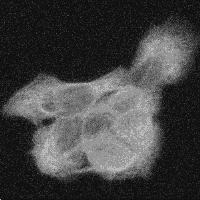 Image taken with an oil objective, aperture 1.4, with very high optical quality, but incorrectly used because the refractive indices were not adapted. The original image is 10x less bright than the correct record on the right. Unsatisfactory quality.
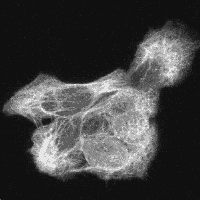 The same area in the specimen, but recorded with the new C-Apochromat 40x/1.2 W Korr. Marked improvement of sharpness, contrast and brightness.
Due to the high transmission, also in the UV part of the spectrum, the objective is also ideal for measurements using ion probes, e.g. FURA. The high aperture also positively influences the quality of the fluorescence photos. List of objectives | |
| Homepage | Business Group | Products | Micro-Contacts If you have any suggestions and/or requests please contact [email protected]. | |