
| 
|
|
MICROSCOPES FOR THE MICROELECTRONICS INDUSTRY / FAILURE ANALYSIS SYSTEMS | |
|---|---|
Laser Scan Microscope for Failure Analysis and Process Control
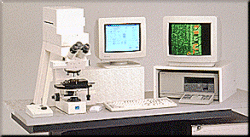 The confocal Laser Scan Microscope (LSM) from Carl Zeiss is the first commercial system to
combine a variety of inspection and probing techniques on an optical workstation. Besides
high-resolution laser scanned imaging for defect inspection, the tool can be used for routine
applications in metrology and profile measurements.
But by adding such powerful and innovative non-destructive tests as OBIC (Optical Beam
Included Current) and Emission Microscopy, the LSM has become a major attraction
in failure analysis labs. The rapid switch over from one test method to the other with
minimum preparation reduces the risk of contamination of the packaged device and the wafer.
Because of its flexibility, the state-of-the-art LSM analysis tool is easy to use
in a lab environment. However, at the same time, it can be fully programmed for routine work
supervised by an operator. This is achieved by a new Windows-based user interface and a powerful
and sophisticated macro capability.
The LSM system incorporates an 8"-inspection microscope and a high-speed laser scanning
optics, which - depending on the task performed - can be equipped with one or two lasers. Only a
software key is required to make the switch over, and conventional brightfield imaging and a TV mode
are additionally available.
The typical selection for the first laser is a 633 nm wavelength and for the second a choise
between 350 nm (UV)/ 488 nm or 1064/1152 nm using an infrared laser. The scanned
image can vary in size, resolution and speed, depending on the application. The powerful
image processing capabilities focus on enhancement of details, 3D and topography presentations,
measurements and multi-image overlay in order to visualize exact locations and size of defects.
Precision image of defects with up to 16.000x magnification are displayed using the UV option
or the 488 nm laser line for maximum resolution. An improved image quality for Liquid Crystal
techniques has been proven. Besides 2D image scans, the system has proven very effective in
scanning profiles with a resolution of 50 nm and up to more than a millimeter: ideal for
metal layer separation and photoresist profiles. No cumbersome 3D computation is needed unlike
confocal spinning disk systems, as the LSM provides a result within a few seconds.
The two most important probing techniques applicable are OBIC and Emission Microscopy. The first
method utilizes the 633 nm laser to scan the chip surface and provides information on inhomogeneities
due to design and overlay problems. Since it doesn't require the time-consuming preparation of an SEM as
needed for the analogous EBIC method, it has become very attractive. Related tests, such as
Latch-up, are part of the analytical capabilities.
Emission Microscopy has gained tremendous imortance recently as a non-destructive procedure
for localization of a number of defects: gate oxide leakage, ESD damage, and hot electrons. These
sites emit a very low optical signal and a very sophisticated low light level image detector
has to be employed. Only a cooled CCD detector with programmable integration time provides the
best image quality and lowest background noise at the same time.
The optical beam path of the LSM and the patented
ICS optics ensure maximum sensitivity in detecting
faint emission spots. Other features include full remote control of the light-tight enclosed LSM
, a scanning stage (up to 8"x8"), and the various imaging modes. Automated spot positioning and
enhancement algorithms are based on experience in the field.
Configuring the LSM with an infrared laser is a novel feature to overcome the shadowing
effects from frontside metal coverage of advanced chip technology. The answer is backside imaging
in confocal mode which puts an end to "fuzzy" images known from TV-based systems. Moreover,
backside OBIC probing and Emission imaging has become a brand-new application.
Defect and measurement site data can be imported from files as well as results can be exported
to a host computer via a network link or can be stored on an hard disk and optical disk and
documented on a color video printer.
The LSM workstation defines a new level of performance for analytical tools and provides tremendous
imaging capabilities in combination with OBIC, Emission, IR imaging and Liquit Crystal probing techniques.
The benefits are: minimal preparation, ease of correlating one technique to another, cost effectiveness,
and an easy source of multiple configurations.
The confocal Laser Scan Microscope (LSM) from Carl Zeiss is the first commercial system to
combine a variety of inspection and probing techniques on an optical workstation. Besides
high-resolution laser scanned imaging for defect inspection, the tool can be used for routine
applications in metrology and profile measurements.
But by adding such powerful and innovative non-destructive tests as OBIC (Optical Beam
Included Current) and Emission Microscopy, the LSM has become a major attraction
in failure analysis labs. The rapid switch over from one test method to the other with
minimum preparation reduces the risk of contamination of the packaged device and the wafer.
Because of its flexibility, the state-of-the-art LSM analysis tool is easy to use
in a lab environment. However, at the same time, it can be fully programmed for routine work
supervised by an operator. This is achieved by a new Windows-based user interface and a powerful
and sophisticated macro capability.
The LSM system incorporates an 8"-inspection microscope and a high-speed laser scanning
optics, which - depending on the task performed - can be equipped with one or two lasers. Only a
software key is required to make the switch over, and conventional brightfield imaging and a TV mode
are additionally available.
The typical selection for the first laser is a 633 nm wavelength and for the second a choise
between 350 nm (UV)/ 488 nm or 1064/1152 nm using an infrared laser. The scanned
image can vary in size, resolution and speed, depending on the application. The powerful
image processing capabilities focus on enhancement of details, 3D and topography presentations,
measurements and multi-image overlay in order to visualize exact locations and size of defects.
Precision image of defects with up to 16.000x magnification are displayed using the UV option
or the 488 nm laser line for maximum resolution. An improved image quality for Liquid Crystal
techniques has been proven. Besides 2D image scans, the system has proven very effective in
scanning profiles with a resolution of 50 nm and up to more than a millimeter: ideal for
metal layer separation and photoresist profiles. No cumbersome 3D computation is needed unlike
confocal spinning disk systems, as the LSM provides a result within a few seconds.
The two most important probing techniques applicable are OBIC and Emission Microscopy. The first
method utilizes the 633 nm laser to scan the chip surface and provides information on inhomogeneities
due to design and overlay problems. Since it doesn't require the time-consuming preparation of an SEM as
needed for the analogous EBIC method, it has become very attractive. Related tests, such as
Latch-up, are part of the analytical capabilities.
Emission Microscopy has gained tremendous imortance recently as a non-destructive procedure
for localization of a number of defects: gate oxide leakage, ESD damage, and hot electrons. These
sites emit a very low optical signal and a very sophisticated low light level image detector
has to be employed. Only a cooled CCD detector with programmable integration time provides the
best image quality and lowest background noise at the same time.
The optical beam path of the LSM and the patented
ICS optics ensure maximum sensitivity in detecting
faint emission spots. Other features include full remote control of the light-tight enclosed LSM
, a scanning stage (up to 8"x8"), and the various imaging modes. Automated spot positioning and
enhancement algorithms are based on experience in the field.
Configuring the LSM with an infrared laser is a novel feature to overcome the shadowing
effects from frontside metal coverage of advanced chip technology. The answer is backside imaging
in confocal mode which puts an end to "fuzzy" images known from TV-based systems. Moreover,
backside OBIC probing and Emission imaging has become a brand-new application.
Defect and measurement site data can be imported from files as well as results can be exported
to a host computer via a network link or can be stored on an hard disk and optical disk and
documented on a color video printer.
The LSM workstation defines a new level of performance for analytical tools and provides tremendous
imaging capabilities in combination with OBIC, Emission, IR imaging and Liquit Crystal probing techniques.
The benefits are: minimal preparation, ease of correlating one technique to another, cost effectiveness,
and an easy source of multiple configurations.
| |
| Homepage | Business Group | Products If you have any suggestions and/or requests please contact [email protected]. | |